
Reviewed · CITY TOURS
Self-Guided Audio City Tour in Zurich
Zurich’s best stories are tucked into ordinary streets, church squares, fountains, and old guild buildings. This self-guided walk connects them in one long route, from Alfred Escher’s railway-era statue to Roman baths, Reformation landmarks, Dada’s birthplace, and the city’s famous churches. The audio adds useful context that a quick stroll can miss.
I like the freedom to set your own pace, and I like the low price of $13.29 for a route that reaches far beyond the main postcard views. The written transcript and route photos are especially handy when city streets get confusing. The main catch is that this is a long walk, and the audio depends on your phone, internet connection, and battery.
I also like the unusual subjects: Lenin’s Zurich apartment, the Hans Waldmann statue, the Max Bill sculpture, and the old Roman bath remains. You will need to pay CHF 5 if you want to enter Fraumünster, and some people may find the church-focused narration more detailed than expected.
Key points before you start
- More than churches and clock towers: The route includes Roman baths, Dada art, political history, guild life, and modern sculpture.
- A flexible audio format: Listen, read the transcript, skip stops, or pause for coffee without waiting for a group.
- Allow extra time: Two to three hours is the basic estimate, but a relaxed walk can take about three and a half to four and a half hours.
- Strong Old Town coverage: Lindenhof, St. Peter’s, Grossmünster, Wasserkirche, Fraumünster, and Weinplatz give you a useful introduction to central Zurich.
- Bring the right tools: You need your own phone, internet, headphones, and enough battery for a long walking route.
- A low-cost introduction: At $13.29, this is an inexpensive way to get oriented before spending more on museums or a live tour.
What this Zurich walk actually offers

This is not a live walking tour with a guide leading you through a group. After booking, you receive a link to an English audio guide, with spoken commentary, written captions, photos, and directions.
That format suits independent sightseeing. You can stop for a drink, step inside a church, take a detour, or skip a location without holding anyone up. The access remains valid for one year from purchase, so you are not forced to complete every stop in one afternoon.
The route begins at Bahnhofplatz, beside the Alfred Escher monument near Zurich’s main train station. It ends at the Max Bill Pavilion Sculpture on Bahnhofstrasse. The planned route includes 111 landmarks, although the major named stops form a more manageable sightseeing chain through central Zurich.
The price is the strongest part of the deal. At $13.29, you are paying less than the cost of many live city tours, while still receiving a substantial amount of historical narration. You are not paying for personal attention, a guide, or admission to attractions. You are paying for the route, commentary, and freedom to explore alone.
More City Tours in Zurich
- Zurich City Tour with Audio Commentary
★ 4.0 · 372 reviews - City tour Zurich with the city whispers from CHF 21.00
★ 5.0 · 242 reviews - Best of Zurich and Surroundings – Extended City Sightseeing Tour
★ 4.0 · 106 reviews
From Alfred Escher to Lindenhof Hill
Begin with Alfred Escher, one of the key figures behind Switzerland’s economic growth and railway system. His statue near the station gives the walk a practical opening: Zurich’s modern importance did not appear by accident. Railways, finance, industry, and political power helped shape the city you see today.
The next stop is Pestalozzianlage, home to a monument honoring Johann Heinrich Pestalozzi. The commentary connects this small urban space with education and social reform. It is a good example of the tour’s method: a statue that might otherwise receive only a passing glance becomes a doorway into Swiss public life.
You then pass the Urania Observatory. The visit is brief, but the observatory adds a scientific note before the route turns toward Zurich’s older center.
Lindenhof Hill is one of the first places where the walk rewards you with a proper view. From this elevated terrace, you can look toward the Limmat River and the city beyond. The audio points out the Hedwig Fountain, the Masonic Lodge, and the Tombstone of Lucius Aelius.
Give Lindenhof more than the listed ten minutes if the weather is good. This is a natural place to pause, take photographs, and get your bearings. The hill also helps you understand Zurich’s layout before the route leads you down into the tighter Old Town streets.
St. Peter’s, the Roman baths, and Zurich’s civic center
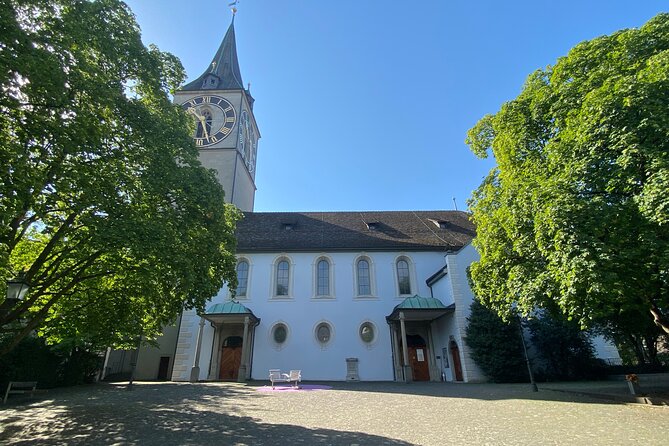
St. Peter’s Church brings you to one of Zurich’s most recognizable sights. Its clock face is among the largest in Europe, and the church is also identified as the city’s oldest parish church. The audio gives you time to consider both the exterior scale and the quieter interior.
Thermengasse offers a sharp change of mood. Here, traces of Roman baths connect present-day Zurich with its ancient past. The remains are not a large archaeological complex, so keep your expectations sensible. Their value lies in the contrast: modern streets and buildings sit above evidence of a much older settlement.
The Town Hall, or Rathaus, shifts the focus to government and civic power. You will hear about Zurich’s political past while viewing a building that remains part of the city’s public center.
These early stops are useful if you are new to Zurich because they place the city’s railway age, educational reforms, Roman era, religious life, and government in one sequence. The drawback is that the narration can feel dense if you have just arrived after a long journey. You can use the written captions or pause the audio whenever you need a break.
Dada, Lenin, and the stories behind the Old Town
Cabaret Voltaire is one of the route’s most distinctive stops. This was the birthplace of Dada, an art movement built around provocation, experimentation, and a challenge to accepted ideas. The setting gives you a different view of Zurich, one that has little to do with orderly banks or polished shopping streets.
The Lenin Apartment adds another unusual chapter. Vladimir Lenin lived in Zurich during political exile, and the audio explains the importance of this period in his life. You do not need to be a specialist in Russian history to appreciate the basic point: this quiet Swiss city offered refuge to people thinking about dramatic political change elsewhere.
These two stops are valuable because they break up the repeated church-and-monument pattern. If you prefer art, politics, and social history to religious architecture, pay close attention here. If your interest is mainly in views and grand buildings, you may find the narration slower than expected.
More audio tours around Zurich:
- Self-Guided Audio Tour to the Dark Side of Zurich
★ 4.5 · 14 reviews - The Best of Basel’s Hidden Treasures: A Self-Guided Audio Tour
★ 4.5 · 32 reviews - Revealing Lucerne: Self-Guided Audio City Tour
★ 4.0 · 20 reviews - Self-Guided Audio City Tour in Bern
★ 4.0 · 17 reviews
Grossmünster and the Reformation quarter
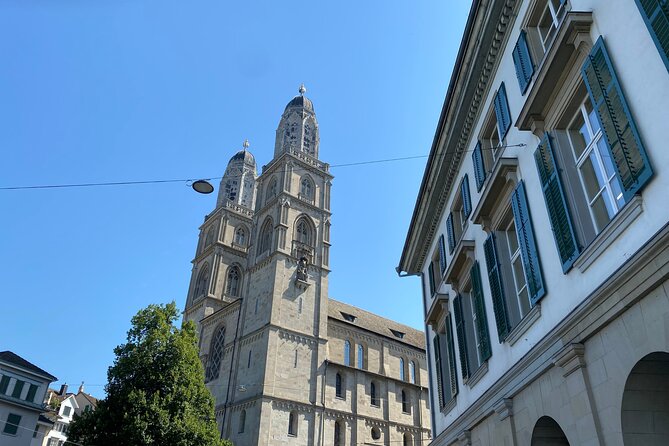
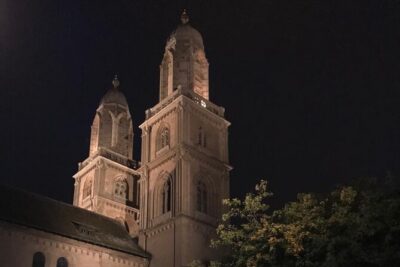
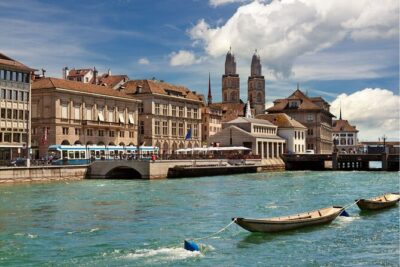
Grossmünster is one of Zurich’s defining landmarks, with twin towers that shape the city skyline. The church played a major role in the Swiss Reformation, and the audio explains its connection to that period.
Inside, look for the stained glass by Augusto Giacometti. The colored windows change the feeling of the interior and give you a reason to step in rather than simply photograph the towers from outside. The planned stop is about 15 minutes, but anyone interested in architecture or church art may want longer.
Nearby Wasserkirche offers a smaller, calmer visit beside the Limmat. Its stained glass windows provide another visual pause, while the Ulrich Zwingli Monument continues the Reformation story. Zwingli was a major Swiss reformer, and his monument presents him as both a religious thinker and a force in Zurich’s public life.
This is the section where the tour gives you the most detail about churches. That is useful if you want a solid introduction to Zurich’s religious past, but it can feel repetitive if you have already visited several European church cities. The self-guided format solves part of the problem: listen to the essential sections and move on when your attention fades.
The Opera House, Ganymed, and Hans Waldmann
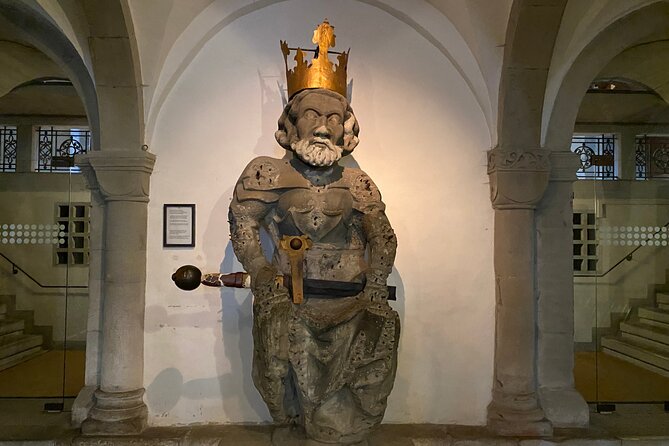
The route then opens up toward the Zurich Opera House. Its facade carries busts of composers and writers, making the building both a performance venue and a public display of cultural figures. The stop is short, but it helps show that Zurich’s identity is not limited to medieval streets and Reformation churches.
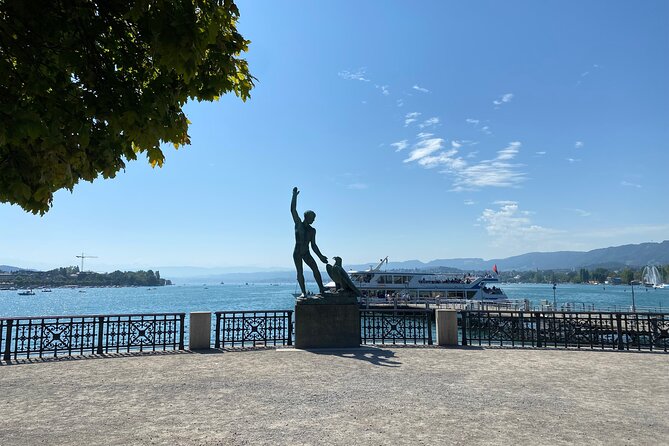
Ganymed is a sculpture based on a classical myth. It gives you a chance to see how Zurich places modern public art within its historic center. The audio provides the story behind the work, so you are not left wondering what the sculpture represents.
The Hans Waldmann statue has one of the more dramatic biographies on the route. Waldmann rose from modest beginnings to become Zurich’s burgomaster, then ended his life after being sentenced to death. His statue is a reminder that power in medieval and early modern cities could be unstable, and that success did not guarantee a peaceful end.
These stops are quick, but they work well as links between the major churches and the financial district. You will see how Zurich’s public spaces combine art, politics, literature, music, and older civic memory.
Fraumünster and the five-franc decision
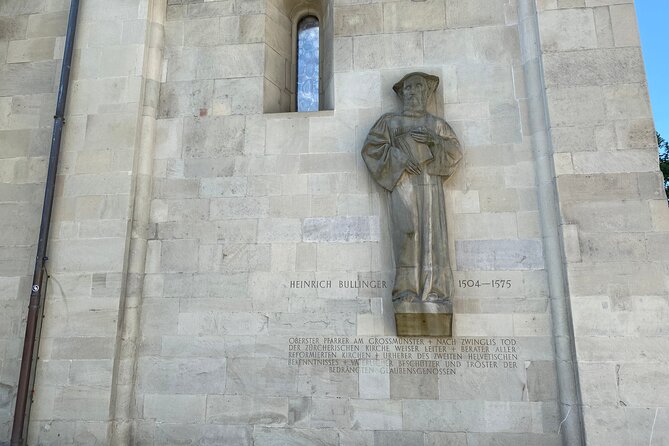
Fraumünster is likely to be one of the most anticipated stops. The church is known for its stained glass windows by Marc Chagall. Light passing through the windows gives the interior its strongest visual appeal, and the audio sets the artwork within the church’s wider religious and artistic setting.
Entry inside is not included. If you decide to visit the interior, the additional charge is CHF 5 per person. That is a modest extra cost, but it is worth knowing before you arrive, especially if you are comparing this walk with a tour that includes admissions.
You can still view the exterior and surrounding square without paying the entrance fee. I would treat the church interior as an optional add-on. Art lovers should budget the five francs. If you have already seen several churches or are trying to keep the afternoon short, the outside view may be enough.
The route also takes you through Paradeplatz, the center of Zurich’s financial district. This is where the city’s banking identity becomes most visible. The square is a good counterpoint to the Roman remains and medieval churches: the walk keeps showing how different eras occupy the same compact center.
Augustinerkirche, Max Bill, and Weinplatz
Augustinerkirche is a modest church with a quiet interior. After Grossmünster and Fraumünster, its simpler character can feel like a welcome change. The stop is brief and suited to a quick look rather than a long visit.
The Max Bill Pavilion Sculpture near Bahnhofstrasse represents transparency, equality, and freedom through a clean modern design. Its appearance differs sharply from the surrounding historic buildings, and that contrast is exactly why the stop works.
The tour ends at Weinplatz, near the Millers’ and Bakers’ Guild Building. Here, the audio turns to workers and guild life in old Zurich. This is a useful closing note because it moves attention away from rulers and churches and toward the people whose trades helped keep the city running.
The finish beside the Max Bill sculpture is not at the train station, so plan your onward route. You remain in central Zurich, near major city sights and public transport, but the end point is different from the starting point.
Timing, navigation, and phone battery
The advertised duration is two to three hours, but that is best treated as a brisk estimate. If you listen at every stop, read the captions, enter churches, take photographs, and pause at Lindenhof, expect closer to three and a half or four hours. One person completed only about 65 of the 111 landmarks during a leisurely outing, which shows how much extra material is available.
Navigation is generally supported by clear directions and photographs. Still, street signs are not always easy to spot, and one user had trouble staying on route. I recommend downloading or opening the route before you start, checking your phone at each stop, and keeping the transcript available if the audio resets.
A stable internet connection matters. The audio has occasionally restarted from the beginning, and there have also been initial problems activating the link. These issues may be frustrating, especially if you are standing on a busy street trying to troubleshoot. Make sure the link is visible in your booking confirmation, and contact support quickly if it does not work.
Bring headphones and a fully charged phone. A portable battery is a smart addition. The route is long enough that low power can turn a pleasant walk into a hunt for a charging point.
Who will get the most from this tour
I would choose this experience if you want an affordable first look at Zurich and prefer not to follow a group. It is especially useful for solo visitors, couples with different interests, or anyone who wants to add shops, cafés, and personal detours without losing the main route.
It also suits history-minded visitors who enjoy connecting small details. You get Roman archaeology, education, railways, Reformation politics, Dada, Lenin, guilds, public sculpture, and banking in one walk.
I would choose a live tour instead if you want questions answered on the spot, help with navigation, or a guide who can adjust the pace and subject matter. The audio cannot notice that you are tired, explain a confusing street in person, or replace the feeling of shared conversation.
The content leans heavily toward early Zurich, churches, and civic history. It does not focus on World War II, bomb shelters, or every part of modern Swiss life. That is not a flaw if you know what you are buying, but it may feel narrow if twentieth-century history is your priority.
Should you book it?
Book this Zurich audio walk if you want a low-cost, flexible introduction with a strong Old Town route and plenty of historical detail. The unusual stops, clear photographs, transcript, and year-long access give it more value than the price suggests.
Skip it if you dislike phone-based sightseeing, need a live guide, or want a short stroll with only the major sights. For everyone else, bring good walking shoes, headphones, internet, and a backup battery. Start early enough to take your time at Lindenhof, Grossmünster, and Fraumünster, and treat the two-hour estimate as the minimum rather than the promise.
FAQ
How much does the self-guided Zurich audio tour cost?
The listed price is $13.29 per person.
How long does the tour take?
The estimated duration is two to three hours. A slower visit with pauses and sightseeing can take about three and a half to four and a half hours.
What language is the audio guide in?
The audio guide is offered in English.
Is there a live guide?
No. You explore independently using the audio link supplied after booking.
What do I need to bring?
You need your own mobile phone with internet and a headset. A fully charged phone or portable battery is also practical for this long route.
Where does the tour begin?
It begins at the Alfred Escher Statue on Bahnhofplatz, near Zurich’s main train station.
Where does the tour end?
It ends beside the Max Bill Pavilion Sculpture at Bahnhofstrasse 47 in central Zurich.
Is entry to the sights included?
The listed stops are free except for Fraumünster. Entering Fraumünster costs CHF 5 per person.
Can I complete the tour in stages?
Yes. Access remains valid for one year from the date of purchase, so you can continue later if you do not finish the route in one day.
Can I cancel for a refund?
You can cancel at least 24 hours before the local start time for a full refund. Cancellations or changes made less than 24 hours before the start time are not accepted for a refund.
More Self-Guided Routes around Zurich
- Einstein in Zurich: Walk in Time Exploration Game and Tour
★ 4.0 · 25 reviews - Zurich Scavenger Hunt and Sights Self-Guided Tour
★ 5.0 · 10 reviews - Mt. Rigi Self-Guided Tour: Lake Lucerne Cruise and Mountain Spa
★ 4.5 · 83 reviews - Self-Guided Chamonix with Aiguille du Midi or Mer de Glace
★ 3.5 · 35 reviews
Recently added in Zurich
- Zurich and Suroundings (Private Tour)★ 5.0 · 7 reviews
- Zurich Scavenger Hunt and Sights Self-Guided Tour★ 5.0 · 10 reviews
- Full-Day Private Zurich Sightseeing Tour and Chocolate Tasting★ 5.0 · 5 reviews
- Day trip to Swiss Villages from Zurich – Small Group Tour by Car★ 5.0 · 8 reviews
- Zürich: Private Car Tour to Rhine Falls, Titisee and Black Forest★ 3.5 · 4 reviews
- Zurich Airport Stress-Free Private Transfer★ 5.0 · 6 reviews
- Zürich, Lindt Chocolate, Rheinfalls and Stein am Rhein★ 5.0 · 14 reviews
- Zurich Like a Local: Customized Private Tour★ 3.5 · 7 reviews
City Tours, compared.
Best of Geneva City Tour with optional boat cruise
Read our review →
City tour Zurich with the city whispers from CHF 21.00
Read our review →

Best of Zurich and Surroundings – Extended City Sightseeing Tour
Read our review →
Private Arrival Transfer: from Zurich Airport to Zurich City
Read our review →
Browse the lists this tour appears in